

Signals in the Noise
A patient-centered framework for identifying where diagnostic information breaks down as patients move through care.
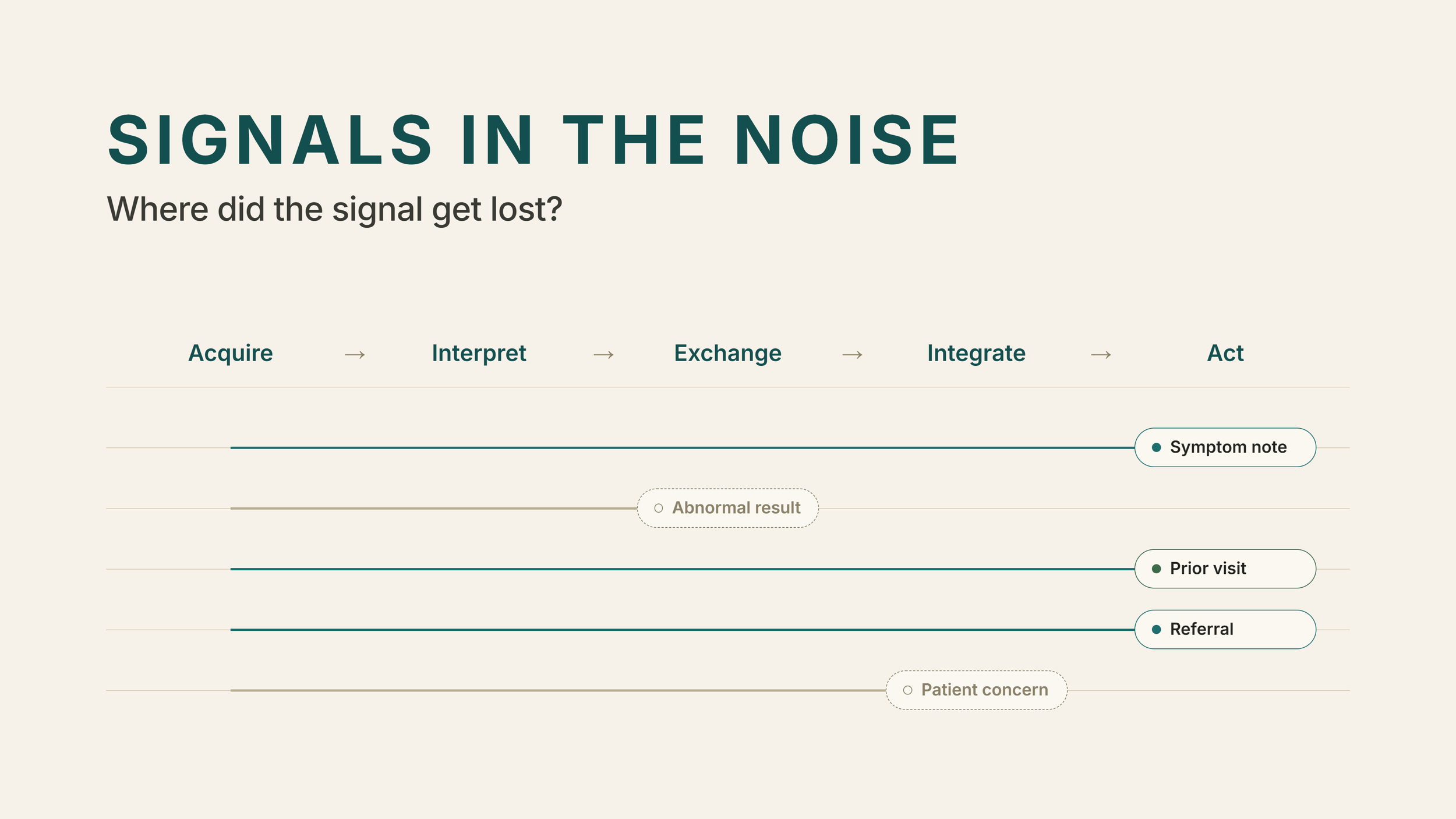
Signals in the Noise gives care teams and patients a practical way to see where clinical and patient information gets fragmented, overlooked, misread, or lost, and where better information practices can support safer, more responsive care
Diagnostic delay is an information problem.
Healthcare generates enormous amounts of information. But more information does not automatically create more understanding.
A patient's story lives across symptoms, clinical encounters, test results, specialist notes, patient observations, and changes over time. The question is rarely whether the information exists. It's whether the right information is sought, recognized, interpreted, communicated, and connected when it matters most.
Signals in the Noise gives you a structured way to examine those points of friction.
The Framework
Signals in the Noise organizes diagnostic information challenges around five practical actions.
-
What information are we gathering, and what might never enter the record?
-
How are available signals being interpreted, weighed, questioned, or dismissed?
-
Does critical information move effectively between patients, clinicians, teams, and settings?here
-
Can information spread across encounters, specialties, and time be understood as one coherent whole?
-
When meaningful information surfaces, does it lead to the right follow up, escalation, or action?
Together, these five actions give teams a shared language for examining how information moves through the diagnostic process, and where that process breaks down.

Understanding where information breaks down is the starting point. Applying that understanding to real teams, workflows, cases, and systems takes deeper work.
Sarayah partners with organizations ready to put the framework into practice through facilitated learning, strategic advisory, and implementation focused engagements.
Workshops & Facilitation Interactive sessions that walk teams through real cases and diagnostic information challenges, and surface concrete opportunities for stronger practices.
Advisory & Consulting Strategic support for organizations examining patient context, documentation, information flow, communication, and other sources of friction across healthcare experiences and workflows.
Speaking & EducationTalks, panels, guest lectures, and educational sessions on diagnostic delay, patient knowledge, healthcare information systems, and where lived experience meets system design.